MAKO Surgical Was the Most Shorted Medtech Stock Before Stryker Paid 1.65 Billion
MAKO Surgical Was the Most Shorted Medtech Stock Before Stryker Paid $1.65 Billion
Key Takeaways
- MAKO had five installed systems and 180 procedures performed when it went public on Valentine's Day 2008, with zero revenue and a collapsing economy
- At the time of the Stryker acquisition, MAKO had a $125 million run-rate revenue, 175 installed systems, and 33,000 procedures performed
- MAKO stock traded at lows near $6 per share before Stryker acquired it at $30, a 17x revenue multiple
- Stryker CEO Kevin Lobo personally flew to meet founder Maurice Ferré in September 2013; the deal was signed on December 17, 2013, in under 90 days
- Approximately 40% of all U.S. knee replacements are now performed with the MAKO robot, validating what Wall Street missed for years
MAKO Surgical was the most-shorted stock in medtech. Wall Street had bet billions it would fail. The company was losing money, the product hadn't reached the total knee market yet, and a difficult quarter was ahead.
Then Stryker CEO Kevin Lobo flew down to Florida personally, sat across from founding CEO Maurice Ferré, and said he was willing to lose his job to get this deal done.
Watch the full conversation with Maurice Ferré on The State of MedTech
How Maurice Ferré Turned Z-KAT Into MAKO Surgical
The company that became MAKO started as Z-KAT, a medical device startup founded by Rony Abovitz with too many projects running at once. A portable navigation device, a robotics platform, a neurostimulation program. Each one is interesting. None of them focused.
Maurice Ferré, MD, joined in 2003 as a consultant after selling his first company, Visualization Technology Inc., to GE. He had spent six months inside GE before deciding corporate life wasn't what he'd signed up for.
Chris Dewey, one of Z-KAT's founding board members and early investors, made the introduction. Listen to Chris Dewey's episode of The State of MedTech
Dewey had come to Z-KAT through Robotic Ventures, his early-stage fund, after a conversation with Rod Brooks, head of artificial intelligence at MIT. Brooks told him medical robotics was about to change, so Dewey flew to Florida, met Rony Abovitz, and watched what the Barrett robotic arm could do.
"I just saw where that could go. This robotic arm could replicate a surgeon's hands as a tool," Dewey said on The State of MedTech.
He invested, then kept the company alive as Z-KAT burned through CEOs trying to find its focus. When the company needed an operator who could make the hard calls, Dewey reached into his network. An investor friend named John Whitman pointed him toward Maurice Ferré, the man who had just sold his company to GE and walked away from corporate life.
Dewey made the call.
When Ferré walked in, he saw a company that needed to make a hard choice.
I recorded this episode with Ferré on December 17, 2024, exactly eleven years after the Stryker deal closed. He described his first assessment of Z-KAT in The State of MedTech:
"When I looked at Z-KAT, it was just a lot of crazy stuff happening. There were too many things going on. So first thing we had to do was figure out what the heck we were going to do here."
— Maurice Ferré, founding CEO of MAKO Surgical (The State of MedTech)
The answer came from a meeting with a doctor named John Repicci, upstate New York, who was doing partial knee resurfacing with a burr instead of a saw.
Repicci had a technically superior approach, but it was extremely challenging to teach anyone to replicate it. The robot could. Ferré built the business plan around that insight.
He then restructured Z-KAT, cut the science projects, focused everything on partial knee robotic surgery, including buying an implant and finally rebranding the company.
The new entity needed a clean capital structure. So Dewey flew to New York and worked his network. Hedge fund manager David Tepper put in a million dollars. Investor David Matlin put in another. Dewey invested his own money alongside them.
"We raised the four million. That was the start of Mako Surgical," Dewey said.
The name came from an afternoon brainstorm. Ferré wanted four letters that could become a Nasdaq stock ticker. The CFO, Fritz LaPorte, who was an avid fisherman, kept coming back to the mako shark. Fast, vision-driven, attacks from beneath, the fewest human attacks of any shark species.
"Minimal Access Keyhole Orthopedics. It was MAKO. And then, Fritz, being the fisherman, came up with the shark. It's the fastest of the sharks. It attacks its prey from underneath, and it doesn't see the threat. It's an aggressive hunter. As the smartest of the sharks, yeah, okay, we'll be a mako."
— Maurice Ferré, founding CEO of MAKO Surgical (The State of MedTech)
Dewey described the spirit behind the name on his episode of The State of MedTech:
"Z-KAT had a butterfly as its symbol, to show how gentle the robot could be. But Z-KAT wasn't working. So we asked: what's the baddest fish in the ocean? Who takes no nonsense from anybody? A mako shark. That's a true story."
— Chris Dewey, founding board member of MAKO Surgical (The State of MedTech)
The First Case and the Surgeon Who Made It Work
A company can have the best robot in the world and still fail commercially if the first clinical champion isn't the right one.
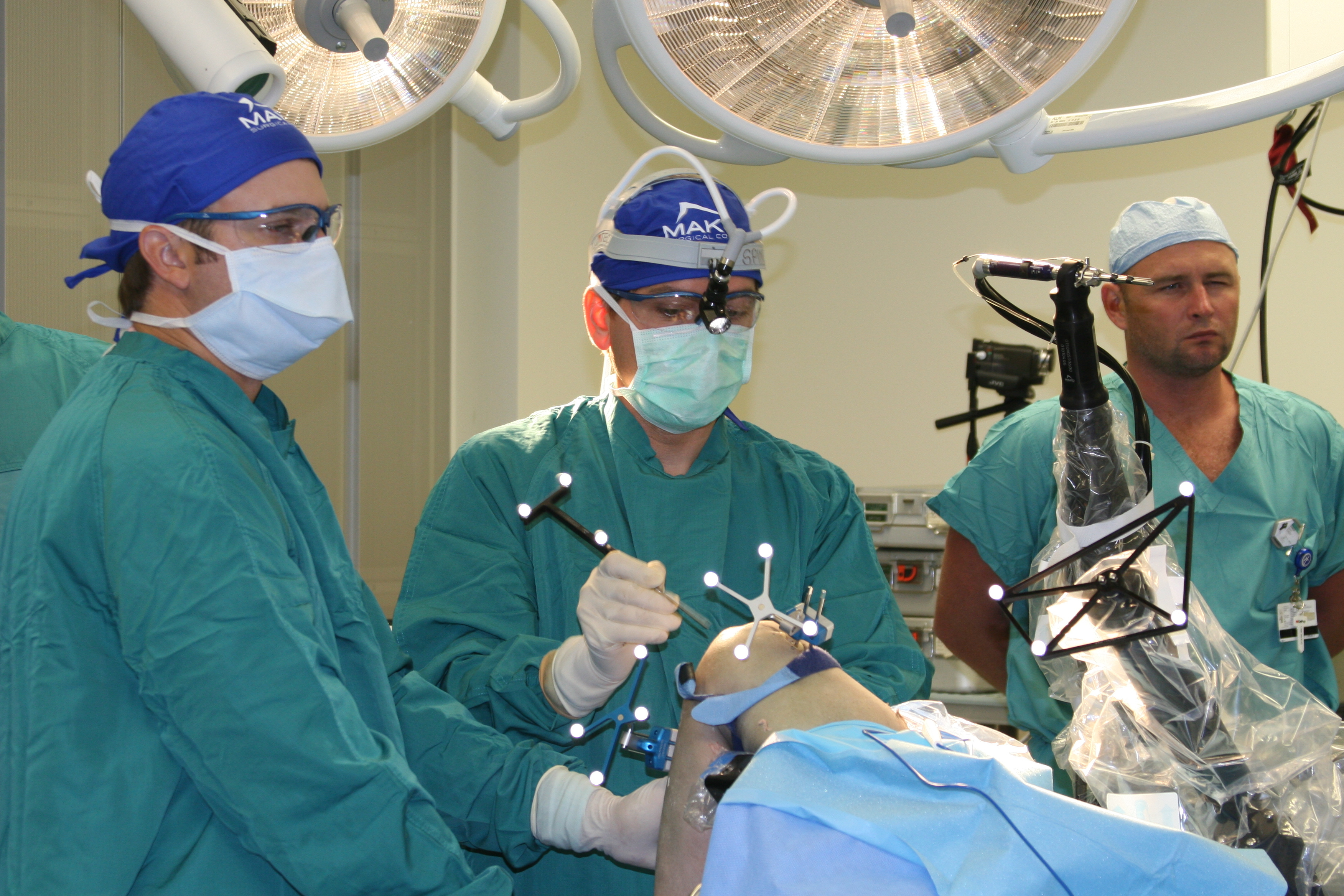
MAKO's clinical champion was Dr. Martin Roche, an orthopaedic surgeon operating at Holy Cross Hospital in Fort Lauderdale, close enough to the MAKO facility to work with the team directly.
Ferré described what made Roche different on the same episode:
"Martin eventually becomes the guy who really brings the magic together. He was technically astute. He had massive volume. And we were able to iterate really quickly. He understands how engineers think."
— Maurice Ferré, founding CEO of MAKO Surgical (The State of MedTech)
That last line is the one most founders miss. Roche didn't just use the robot. He could translate clinical feedback into engineering language and engineering constraints back into clinical terms. That feedback loop compressed years of product development.
The first surgery with MAKO happened in June 2006 at Holy Cross. The system had cleared the FDA using a regulatory strategy that layered small clearances incrementally, rather than pursuing a single de novo path.
That approach, engineered by regulatory specialist William Tapia, gave MAKO FDA clearance before the commercial-grade system was even ready.
They spent two more years building toward the commercial product. By the time MAKO went public, the team had used those two years to build the early clinical evidence they needed.
The IPO Nobody Should Have Attempted

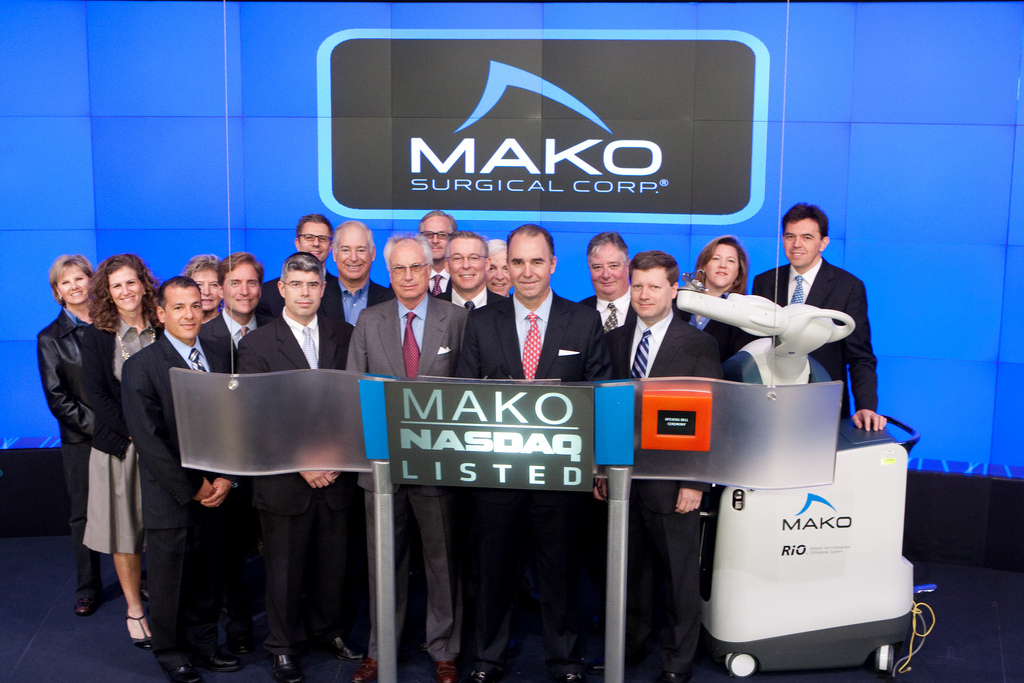
Valentine's Day 2008. MAKO had five installed systems, 180 procedures performed, and zero revenue. The U.S. financial system was in full collapse.
They went public anyway.
Ferré had been through enough to know that waiting was not an option. The capital window would not reopen. If they pulled the plug on the IPO, MAKO would run out of cash. So they held their ground and pushed through a market no one else was entering.
The IPO was its own market engineering signal. Going public at those metrics, in that environment, sent a message to the entire orthopaedic robotics space: MAKO believed in the category enough to stake the company on it.
By 2013, five years later, the company had a $125 million run-rate revenue, 175 installed systems, and 33,000 procedures completed.
The market was forming. But the stock was still trading at lows near $6. The shorts had not given up.
The 90 Days That Ended the Short Position

Kevin Lobo had taken over as Stryker's CEO in 2012. He had a clear read on where orthopaedic surgery was going. He had also, years earlier at J&J, tried to convince his leadership to buy Intuitive Surgical. They didn't listen. He was not going to make that mistake twice.
In September 2013, Lobo contacted Ferré directly. One on one. No banker intermediaries, no business development teams.
"He said he wanted to come down and meet me. We sat down for about three or four hours. He told me his story: that when he was in J&J, he had a very difficult time because he wanted to buy Intuitive, and J&J never let him do it when he was running Ethicon. He said, 'I don't want this to happen again. I want to make this happen. And I've got a full mandate to try to get this done.'"
— Maurice Ferré, founding CEO of MAKO Surgical (The State of MedTech)
The deal moved from the first dinner in September to closing the transaction on December 17, 2013. Under 90 days start to finish.
MAKO's stock moved from $12 to $30 on announcement day. The 17x revenue multiple shocked Wall Street. On the same episode, Ferré described what Lobo told him, which captured the weight of the bet:
"He said: I can lose my job. I'm not going to lose the company. The company's not going to go down on this. But I could lose my job. And for two or three years, they were tough years because they didn't have it right. They were still going after the full knee. I give them a lot of credit."
— Maurice Ferré, on Kevin Lobo's words to him (The State of MedTech)
Lobo was right to be patient. By 2019, Stryker publicly stated the investment had paid off. Approximately 40% of knee replacements in the United States are now performed using the MAKO robot.
Ferré offered his own verdict on the deal at the end of our conversation:
"I give a lot of credit to Kevin Lobo. And you know, I wouldn't change it for anything. Because it's very hard to sit down in a company and say: How can you turn down a 17x multiple? And at the time, it was the right thing."
— Maurice Ferré, founding CEO of MAKO Surgical (The State of MedTech)
What This Means for Medtech Founders
In 370+ episodes of State of MedTech, I've watched the pattern repeat. The companies that get acquired at strong multiples have customers who have nowhere else to go. Revenue is a lag indicator.
MAKO had 175 systems at acquisition. Not a massive install base. But every one of those systems was being used consistently, and every account was asking for more.
Surgeons were building their practices around MAKO procedures. That pull, not the revenue number, is what Lobo was reading when he booked the flight to Fort Lauderdale.
In my experience working with medtech founders, the companies that exit well share one trait: the right clinical champion found early, and that champion's feedback is treated as product direction, not just endorsement.
Ferré found Martin Roche in 2004. Roche became the feedback loop that compressed MAKO's product cycle. The robot that Stryker bought in 2013 was, in large part, built on what Roche taught the team in Fort Lauderdale a decade earlier.
That is what market engineering looks like before it becomes a category. You pick the one surgeon who understands the product well enough to help build it, you build around their specific workflow, and you let word of mouth do the commercial expansion work.
You do not scale the sales team before that foundation is in place.
MAKO's $1.65 billion exit was not a surprise to anyone paying attention to surgical adoption curves. It was only a surprise to the shorts.
Frequently Asked Questions
Why did Stryker acquire MAKO Surgical?
Stryker CEO Kevin Lobo recognized that MAKO had built genuine pull among orthopaedic surgeons for robotic partial and total knee replacement. When he approached founding CEO Maurice Ferré directly in September 2013, MAKO had a $125 million run-rate revenue, 175 installed systems, and 33,000 procedures performed.
Lobo had previously tried to acquire Intuitive Surgical at J&J and had been blocked. He was not going to miss the robotic orthopaedics category at Stryker. The deal closed in under 90 days, on December 17, 2013.
How much did Stryker pay for MAKO Surgical?
Stryker paid approximately $1.65 billion to acquire MAKO Surgical in December 2013. The deal represented a 17x revenue multiple on MAKO's $125 million run-rate revenue at acquisition. MAKO stock had traded at lows near $15 per share before the announcement.
The acquisition price was $30 per share. By 2019, Stryker publicly stated the investment had paid off. About 40% of U.S. knee replacements are now performed using the MAKO robotic system.
Who founded MAKO Surgical?
MAKO grew from Z-KAT, a medical robotics company that developed the core cable-driven haptic robotic technology. Maurice Ferré, MD, joined as the operating CEO in 2004, restructured the company around robotic partial knee replacement, spun out MAKO Surgical, and led it through the 2008 IPO and the 2013 Stryker acquisition.
The name MAKO was also an acronym for Minimal Access Keyhole Orthopedics, coined by Ferré and his team. Co-inventor Rony Abovitz developed the underlying robotic technology.
What is the MAKO robot used for today?
After Stryker's acquisition, the MAKO robotic system was expanded from partial knee replacement to total knee, total hip, and reverse shoulder replacement. It is now used across hundreds of hospitals in the United States and internationally.
According to Stryker's Q4 2025 earnings call, over two-thirds of Stryker's U.S. knee procedures are now performed with MAKO, validating what Wall Street missed for years.
Listen to Maurice Ferré's Full Story
Maurice Ferré's full conversation with Omar Khateeb is on The State of MedTech. Recorded on December 17, 2024, the eleventh anniversary of the Stryker acquisition. Watch on YouTube. Subscribe wherever you listen to podcasts.
For additional context on the technology origins and the 2008 IPO, Rony Abovitz's episode covers the engineering story behind the Z-KAT to MAKO transition. For Chris Dewey's perspective as MAKO's founding board member, listen to his episode of The State of MedTech.
About Maurice Ferré, MD
Maurice R. Ferré, MD, is a serial medtech entrepreneur and the founding CEO of MAKO Surgical Corporation. He sold his first company, Visualization Technology Inc., to GE before joining Z-KAT in 2003 and transforming it into MAKO Surgical.
He led the company through its 2008 IPO and negotiated the 2013 Stryker acquisition personally. He currently serves as CEO of Insightec, a company pioneering incisionless brain surgery using focused ultrasound technology. He is based in Miami.
About the Author
Omar Khateeb is the founder of MarketCraft and host of The State of MedTech, the number one podcast in the medtech industry.
He works with medtech founders and commercial leaders on market engineering, commercialisation strategy, and revenue growth. Visit marketcraft.ai or subscribe to The State of MedTech for weekly conversations with the people building the future of medical devices.